By Agustina Ale
The FIFA World Cup is, without a doubt, much more than just a football tournament. Over the years, this event has evolved into a cultural, social, and emotional phenomenon that goes far beyond sports. Every four years, the entire world seems to pause around a single axis: a black-and-white ball rolling across a field and the shared anticipation of millions of people watching the same thing at the same time.
However, reducing the World Cup to merely a competition between national teams would be an oversimplification of its impact. It is a global collective experience in which national identity, emotion, economics, politics, and popular culture intertwine in complex ways. In each country, the World Cup is experienced differently, shaped by footballing history, social context, and the role the sport plays in everyday life.
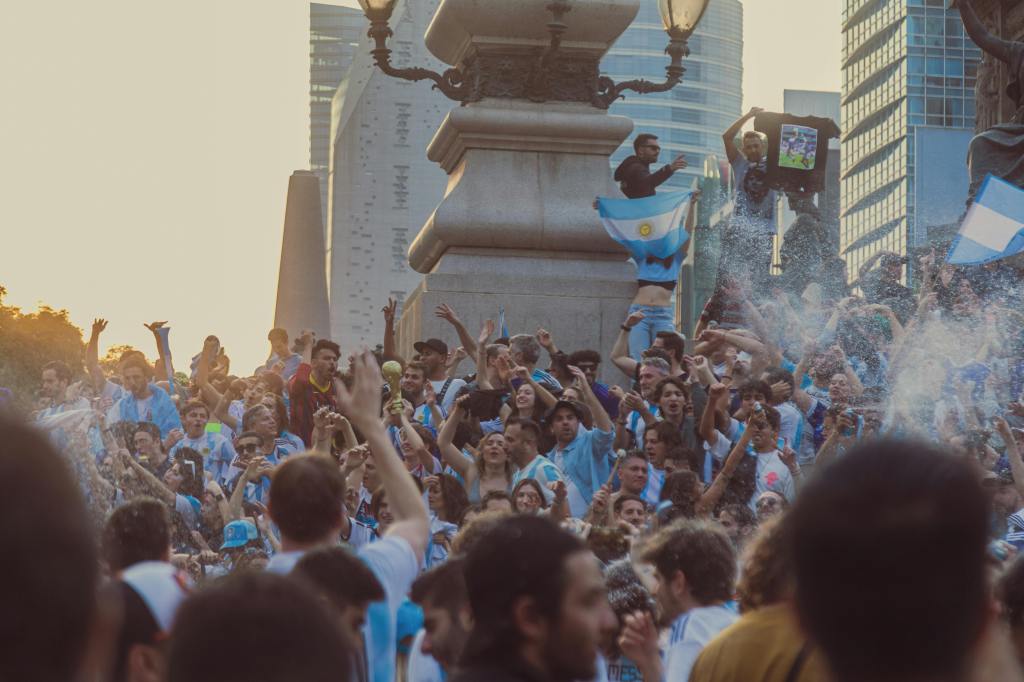
In countries like Argentina or Brazil, football is not simply entertainment but a fundamental part of national identity. The passion is intense and emotionally unavoidable. During the World Cup, cities transform. Streets fill with flags, work schedules adapt to match times, and daily routines are suspended in front of screens. Each match is experienced as a collective event, where the result goes beyond sport and becomes a matter of national pride. In these contexts, football is not just a sport but also a form of cultural expression.
Being from Argentina, football is something that is part of my everyday life. No one in my family plays football, but in Argentina, you don’t need to know someone who does; you just have to step outside to find people playing.
Argentine football is difficult to explain; clubs are everywhere, across all divisions and for all ages. The passion here is unmatched by any other country. In school, you are encouraged to play football, and I’m sure that 99% of Argentine men have played it at some point.
Having Lionel Messi in the national team, playing for the country, marked the beginning of a new era of passion; and before him, Diego Maradona. Two fundamental figures in Argentine football.
I vividly remember when we won the 2022 World Cup and all Argentinians went out into the streets to celebrate—it was a kind of madness that is impossible to describe. Our country is constantly going through economic difficulties; we are a nation that struggles every day to move forward, yet football is something that, almost magically, unites us. That day, Sunday, December 18, 2022, the world stopped, and in Argentina, we were happy. You stepped outside and everything was noise, smiles, strangers hugging, drinking fernet with cola, and celebrating in the same jersey. Everyone wearing the same two colors, playing for the same side.
Don’t expect to understand it.
In contrast, in countries like the United States or Japan, football does not hold the same central place in sports culture. Other sports, such as basketball, baseball, or American football, are more prominent in everyday life. However, this does not mean the World Cup goes unnoticed.
People who don’t usually follow football begin to engage, whether out of curiosity, social influence, or the appeal of a global event. Bars, public spaces, and social media become meeting points where the World Cup acts as a common language. In this sense, the tournament serves as an entry point into football for audiences outside its traditional culture.
One of the most interesting characteristics of the FIFA World Cup is precisely its ability to adapt to different cultural realities without losing its essence. In some places, it is experienced with almost religious fervor, while in others it is more of a social event. But in every case, it generates something.
Around it, a network of industries emerges, finding in the event a unique opportunity for visibility and participation. Music, for example, plays a central role. Each edition features official songs performed by international artists, aiming to capture the spirit of the tournament, be catchy, and contribute to the spectacle.
Design also plays a key role. From the aesthetics of the stadiums to the visual identity of each edition, including national team jerseys and even the ball itself, everything is carefully planned.
At the same time, marketing and advertising reach one of their highest peaks during the World Cup. Major global brands develop specific campaigns, sponsor teams and players, and seek to associate their image with the emotion of the tournament. The World Cup thus becomes a global platform where commercial interests, emotional narratives, and positioning strategies intersect.
Television—and more recently, digital platforms—play a fundamental role in shaping this experience. Broadcasts not only show matches but also build narratives, analyze plays, generate debates, and amplify every moment. This is further enhanced by the impact of social media, where users comment, react, and create content in real time, turning the World Cup into an interactive and continuous experience.
The tournament also sparks important debates about sport and society. One of them is economic: how can it be justified that football players earn such high salaries compared to other essential professions? This question often arises during each edition of the tournament on platforms like X (formerly Twitter). A doctor, for example, may save lives every day and yet not reach the income levels of a sports figure. This disparity fuels discussions about the value of entertainment, the sports industry, and global economic priorities.
Another debate concerns the meaning of success in football. Becoming a professional footballer is a dream for many children around the world. However, that dream can be interpreted in multiple ways: fame, money, recognition, or the opportunity to represent one’s country.
At the same time, the event coexists with deeply contrasting realities. While millions celebrate goals and results, other parts of the world face conflicts, crises, or wars. This duality raises an unavoidable reflection: the coexistence of global celebration with the inequalities and tensions of the contemporary world.
However, it is also important to recognize the unifying aspect of the World Cup. Despite its contradictions, the tournament creates a unique space for global connection. For a few weeks, people from different countries, languages, and cultures share the same narrative. A form of international community is created, based on emotion and sport, even if only temporarily.
The World Cup also has a strong impact on the cultural representation of countries. National teams not only compete in sports terms but also symbolize collective identities. Each team carries with it a history, a style of play, and a way of being perceived by the world. In this sense, the tournament becomes a global showcase where countries present themselves.
This opens another interesting question: do players truly represent their countries 100%? Or is their public image also shaped by media, social expectations, and sporting achievements? It also raises the question of whether a player’s actions off the field influence how their country is perceived, or whether their sporting identity is independent of their personal life.
Ultimately, the FIFA World Cup cannot be understood solely as a sporting competition. It is a global phenomenon that reveals how societies relate to identity, emotion, consumption, and cultural representation. Its impact varies from country to country, but its ability to create connection is universal.
About the Author:
My name is Agustina Ale. I’m Argentine, a publishing editor, social media manager, and deeply passionate about books and communication. Through @casadeditora—the space where I share content on Instagram and TikTok—I dedicate myself to promoting and discussing the publishing world through recommendations, news, and reflections from both the national and international literary scene.
Photo by ExploreWithTunde via Wikimedia Commons, licensed under CC BY-SA 4.0.
 RICO MAGAZINE
Leave a comment